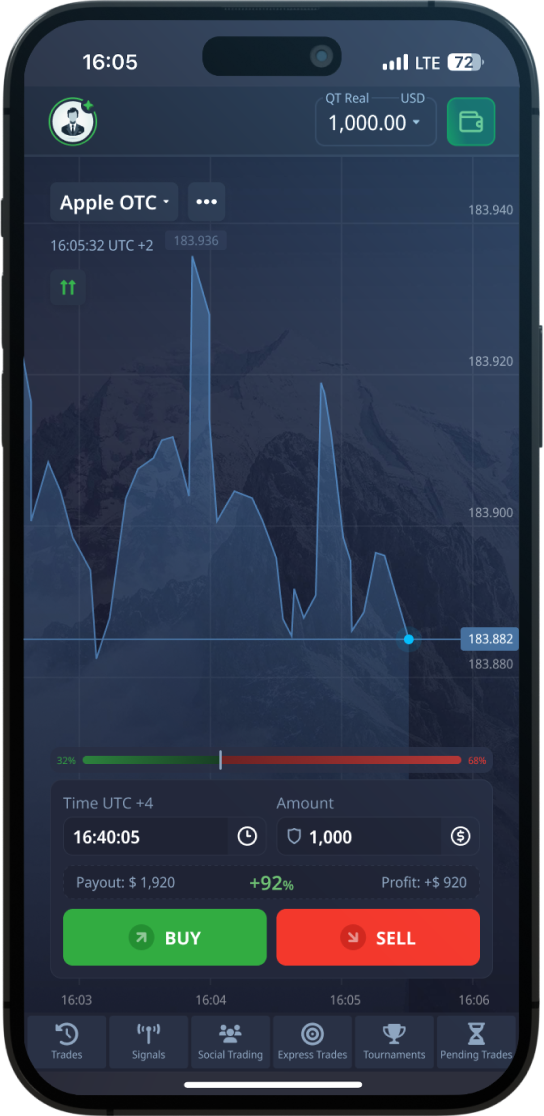
Deposit bonuses, free balance offers, cashback and promo codes can stretch your trading budget — but only if you understand the wagering rules attached to them. This guide explains every bonus type in the Pocket Option app, shows you exactly how to enter a promo code, and is honest about the turnover conditions you have to meet before bonus funds become withdrawable.

Pocket Option runs several promo formats at once. Each one behaves differently when it comes to wagering, withdrawals and expiry, so read the terms attached to the specific offer before you accept it.
A percentage added on top of the money you put in — for example, a 50% bonus turns a $100 deposit into a $150 balance. The bonus portion is locked until you meet the turnover requirement, while your own deposit usually stays withdrawable.
A short alphanumeric code you enter manually to unlock a special percentage or a fixed credit. Codes are time-limited and often tied to a campaign, an influencer, or a holiday event. The same code can carry different terms than the standard deposit offer.
A small balance granted for completing a step such as verifying your account or finishing onboarding. It lets you test the platform without funding it first, but it almost always has the strictest wagering and the lowest cap on what you can withdraw.
A partial return of net losses over a defined period, credited back to your account automatically or on request. Cashback is one of the more trader-friendly perks because it is usually paid as real, withdrawable funds rather than locked bonus money.
Pocket Option runs free and paid trading tournaments with prize pools. Finishing high on the leaderboard rewards you with credit or cash. Free tournaments are a low-risk way to earn extra balance, though prize funds may still carry conditions.
Reload bonuses on later deposits, status-tier rewards, and seasonal promotions appear regularly in the app. As your trading activity grows, your account tier can unlock better rates, faster support and occasional personalized offers.
Entering a code takes under a minute inside the Pocket Option mobile app. Follow these steps and always confirm the terms before the bonus is applied to your balance.
Launch the app and go to the deposit screen, or open the promotions area from the main menu. This is where active offers and the promo-code field appear. Make sure you are logged into the correct account first.
Look for a box labeled promo code, bonus code, or coupon. On the deposit screen it usually sits below the amount selector. If you do not see it, check the dedicated promotions tab where codes can also be redeemed.
Type or paste the code with no extra spaces and the correct capitalization. Codes are case-sensitive in many campaigns, so a single wrong character will be rejected. Double-check the source of the code to be sure it is still valid.
Before confirming, review the bonus percentage, the minimum deposit, the wagering multiplier and the expiry date shown for that code. These details decide whether the offer is worth taking for your trading style and budget.
Fund your account with at least the minimum amount the offer requires, using a supported method such as a card, e-wallet, or Bitcoin. The bonus is calculated from the deposit, so a larger qualifying deposit gives a larger bonus within the offer's cap.
Apply the code and verify that the bonus appears in your account. Your balance should reflect the deposit plus the bonus credit. If the bonus does not show, contact support with the code and your deposit details.
Promo codes and deposit offers are redeemed inside the Pocket Option mobile app. Download the version for your device, then sign in or register to start.
The figures below are typical ranges to show how different bonus formats compare. Exact terms change per campaign and per region, so the conditions displayed on the specific offer in your app always take priority.
| Bonus type | Typical size | Wagering (turnover) | Withdrawable when |
|---|---|---|---|
| First deposit bonus | Up to 50–100% | x35–x50 of bonus | Turnover requirement is met |
| Promo code bonus | Varies by campaign | x40–x50 of bonus | Code conditions completed |
| No-deposit credit | Small fixed amount | Highest multiplier | Strict cap, after wagering |
| Reload bonus | 20–50% on later deposits | x35–x45 of bonus | Turnover requirement is met |
| Cashback | Share of net losses | Often none / minimal | Usually immediately |
| Tournament prize | Prize-pool share | Depends on event rules | Per tournament terms |
A bonus is extra balance the platform adds to your account, but it is not the same as your own money until you satisfy a condition called wagering, sometimes labeled turnover. Wagering is expressed as a multiplier such as x40, which means you must trade a total volume equal to forty times the bonus amount before the bonus and any profit it generated can be withdrawn. So a $50 bonus with x40 wagering requires $2,000 in total traded volume to clear, regardless of whether those trades win or lose along the way.
It is important to separate the two parts of your balance. Your deposited funds are usually yours to withdraw at any time, while the bonus portion sits locked until the turnover is complete. Some offers freeze the entire balance once you accept a bonus, and others keep your deposit free and only restrict the bonus credit. Because this varies, the single most useful habit is to read which model applies before you confirm any promo code or deposit offer in the app.
Wagering exists to stop people from instantly cashing out free credit, and that is a normal part of how almost every trading and betting bonus works. The trade-off is real: a generous percentage with a very high multiplier can be harder to clear than a smaller bonus with a fair multiplier. Treat the wagering number as the real price of the bonus, not the headline percentage, and decide whether your usual trading volume can realistically reach the target before the offer expires.
Active promotions live in two main places inside the Pocket Option app: the deposit screen, where deposit-linked offers and the promo-code field appear, and a dedicated promotions or bonuses tab in the main menu. Tournaments have their own section with entry rules and live leaderboards. Checking both areas before you fund your account ensures you do not miss a better rate that could be applied to the same deposit.
Promo codes themselves are distributed through official channels — email newsletters, the app's notification feed, verified social accounts and partner campaigns. Be cautious with codes shared on random forums or unofficial sites, because expired or fake codes simply will not validate and, worse, some scam pages imitate the brand to harvest logins. When a code does not apply, the safest move is to reach out to in-app support rather than re-entering it on a third-party page.
Most bonuses are lost not because the trading went badly, but because of avoidable mistakes with the terms. The first is missing the expiry date: every bonus has a window, and if you have not cleared the wagering by then, the bonus and any locked profit it produced are typically removed. Before you accept an offer, work out roughly how much volume you trade in a normal week and check whether reaching the turnover target inside that window is actually plausible for you.
The second common pitfall is breaking a rule that voids the bonus automatically. Some offers cap the maximum trade size while a bonus is active, restrict certain instruments, or forbid requesting a withdrawal before wagering is complete — and pulling money out early can cancel the unmet bonus entirely. Read the fine print attached to the specific code, not just the marketing percentage, so a single overlooked condition does not erase the credit you were working to clear.
Finally, treat a bonus as a budget extension, never as a reason to over-trade. A locked bonus can tempt traders into bigger or more frequent positions purely to hit the turnover faster, which raises real risk on real money. The disciplined approach is to keep your normal strategy and position sizing, let the wagering accumulate naturally through trades you would make anyway, and walk away from any offer whose conditions you cannot comfortably meet.
A frequent source of confusion is how a bonus interacts with withdrawals. In most setups, once you accept a bonus, the platform expects you to complete the wagering before you cash out the bonus-linked funds; attempting a withdrawal earlier can forfeit the unmet bonus while still returning your own deposited money. If you prefer maximum flexibility — for instance, you may need to withdraw at short notice — you can usually decline a bonus and trade with deposit funds only, keeping your balance entirely unrestricted.
It also pays to match the bonus to your funding method and budget. Card, e-wallet and Bitcoin deposits may have different minimums, and the bonus is calculated from the qualifying deposit up to the offer's cap, so a deposit far above the cap will not earn proportionally more bonus. Plan the deposit amount around the cap and your real trading appetite, rather than maximizing the deposit just to chase the largest possible headline bonus figure.
Bonuses make trading look cheaper, but they never change the underlying reality: trading carries genuine risk, and you can lose money, including your deposit. No promo code, cashback or tournament prize guarantees profit, and any source promising guaranteed returns is misleading you. Treat extra balance as a buffer that lets you learn and test strategies on the same risk you would otherwise take, not as a shortcut to easy income.
Set limits before you start: decide how much you are willing to risk, stick to a position size you would use without any bonus, and be ready to stop if a campaign's conditions push you toward behavior you are not comfortable with. The healthiest way to use bonuses is selectively — accept the ones with fair, clearable terms, skip the ones with punishing wagering, and always keep your own risk management in charge rather than the promotion.
A deposit bonus is a standard percentage automatically offered when you fund your account, such as 50% on your first deposit. A promo code is a specific alphanumeric code you enter manually to unlock a particular offer, which may carry a different percentage, a fixed credit, or special terms tied to a campaign. Both end up as bonus credit in your balance, but the code-based offer can have its own wagering and expiry rules. Always read the conditions shown for the exact code you enter.
Open the Pocket Option mobile app and go to the deposit screen, where a promo-code or bonus-code field usually appears below the amount selector. Some codes are also redeemable from the dedicated promotions tab in the main menu. Enter the code exactly, with the correct capitalization and no extra spaces, then make the qualifying deposit. After confirming, check that the bonus credit appears in your balance.
Wagering, also called turnover, is the total trading volume you must complete before a bonus and its associated profit become withdrawable. It is shown as a multiplier of the bonus amount — for example, x40 means you must trade forty times the bonus value. Both winning and losing trades count toward this volume, so it is about activity, not profit. Until you clear the wagering within the bonus's time window, the bonus portion of your balance stays locked.
No. Bonus credit is locked until you meet its wagering requirement, and trying to withdraw before that is usually not permitted for the bonus funds. In many cases, requesting a withdrawal while a bonus is active can cancel the unmet bonus entirely, although your own deposited money typically remains yours to withdraw. If you want full flexibility to cash out at any time, you can decline the bonus and trade with deposit funds only.
Not at all. Accepting a bonus commits you to its wagering and any restrictions, such as maximum trade sizes or withdrawal limits, while it is active. If you prefer to keep your whole balance unrestricted — for example, because you may need to withdraw soon — you can decline the offer and trade normally. Accepting a bonus is a choice, and it only makes sense when the terms are realistic for your trading volume.
The most common reasons are an expired code, a typo, incorrect capitalization, or a code that does not apply to your region or account type. Some codes are single-use or limited to new accounts only. First, confirm you copied the code exactly from an official source with no extra spaces. If it still fails on a valid deposit, contact in-app support with the code and your account details rather than re-entering it on any third-party site.
Cashback returns a portion of your net losses over a set period, crediting it back to your account. It differs from a deposit bonus because it is usually paid as real, withdrawable funds with little or no wagering, rather than locked bonus credit. That makes it one of the more trader-friendly perks. The exact percentage and the period it covers depend on the specific cashback campaign or your account tier.
No. A bonus increases your trading balance, but trading itself carries real risk and you can lose money, including your deposit. No bonus, promo code, cashback, or tournament prize changes the chance of any individual trade winning or losing. Any website or person promising guaranteed returns from a bonus is misleading you. Treat extra balance as a budget extension for learning and testing, not as a way to earn risk-free income.
If the bonus window ends and you have not met the turnover requirement, the bonus credit and any profit still locked to it are typically removed from your account. Your own deposited funds and any profit that has already become withdrawable are generally unaffected. This is why it is essential to check the expiry date upfront and confirm your normal trading volume can realistically reach the target in time. If it cannot, declining the bonus is often the smarter choice.
Most disappointment with a bonus comes from skipping the terms screen, not from the bonus itself. Inside the Pocket Option app, every promotion has a short set of conditions attached, and the same headline percentage can behave very differently depending on the fine print. Before you tap accept, slow down and look for the four numbers that actually control your money: the maximum bonus amount, the wagering multiplier, the minimum deposit that unlocks it, and the time window you have to clear it. Those four values, not the marketing banner, decide whether an offer is worth taking.
The terms also tell you how the bonus interacts with your real balance. Some promotions add the bonus as a separate pool that converts to withdrawable funds only after wagering, while others treat your deposit and bonus as one mixed balance. That difference matters when you want to cash out early, because pulling money out can cancel an unfinished bonus and forfeit the credited amount. Read whether partial withdrawals are allowed and what happens to the bonus if you take one.
Finally, check the eligibility rules. Bonuses are often limited to one per account, one per device, or one per payment method, and they may exclude certain deposit channels or regions. If you have already used a similar offer, a new code can be rejected silently. Knowing these limits up front saves you from chasing an offer that your account was never qualified for in the first place.
Pocket Option style promotions usually fall into two practical families, and they suit very different goals. A deposit match scales with the money you add, so a larger first deposit unlocks a larger credited amount up to the cap. These are best when you already planned to fund your account and want extra trading room, because the wagering is calculated on a known balance and you control the size by choosing your deposit. The trade-off is that you must commit your own capital first to see any benefit.
A no-deposit or activity reward, by contrast, lands in your account without funding and is meant to let you try the platform with very little personal risk. The catch is almost always tighter terms: smaller amounts, higher turnover requirements relative to the credited value, and stricter caps on how much of any resulting profit you can withdraw. Treat these as a way to learn the interface rather than a path to meaningful gains, because the limits are designed to keep payouts modest.
The smart approach is to match the bonus type to what you would do anyway. If you are about to deposit regardless, a match offer adds value at no extra commitment. If you are merely curious and not ready to fund, a no-deposit reward or a free demo session is the lower-risk way to explore. Forcing a deposit just to chase a match you do not need is how a bonus quietly becomes a cost rather than a benefit.
Once a bonus is active, you need a way to see how far you are from clearing it, otherwise you are trading blind. The app keeps a running view of your remaining wagering requirement, usually in the account or promotions area, and it is worth checking after each session. Watching the figure drop tells you whether your usual trade size will realistically finish the requirement inside the validity window, or whether the pace is too slow and the bonus will lapse before you complete it.
Code entry is the other place people lose value through simple errors. Promo codes are case sensitive and often time limited, so a code copied with an extra space, a swapped letter, or a missing character will be refused even when it is otherwise valid. Codes are also frequently tied to a fresh deposit, a specific campaign date, or first-time use, which means an expired or already-redeemed code returns a generic rejection that tells you little about the actual cause. Paste carefully, enter the code before confirming the deposit, and use the offer while the campaign is still live.
It also helps to keep your own short record of which offers you have claimed and when they expire. Because many promotions are one-time per account, that note stops you from wasting effort on a code your account can no longer use, and the expiry dates let you prioritize the bonus closest to lapsing. A two-line memo is enough to keep several overlapping offers straight without relying on memory.
How each reward typically behaves so you can choose the one that fits your plan
| Bonus type | Funding needed | Typical wagering | Best use case |
|---|---|---|---|
| First deposit match | Yes, your own deposit | Moderate, based on bonus size | Adding trading room when you were going to deposit anyway |
| No-deposit reward | None | High relative to amount | Trying the app with minimal personal risk |
| Reload or repeat-deposit match | Yes, a new deposit | Moderate | Extending an account you already use actively |
| Cashback | Yes, normal trading | Usually none or low | Softening losses over time without lock-in |
| Promo code offer | Often a fresh deposit | Varies by campaign | Stacking an extra credit on a planned deposit |
Usually not in a way that stacks freely. Most promotions are designed to run one at a time per account, and accepting a new offer while another is still being cleared can pause, replace, or cancel the first one. Always read whether a code combines with an existing bonus before you enter it. If the terms do not explicitly allow stacking, assume the newer offer takes over and the unfinished one may be lost.
No, not until you meet the conditions attached to it. A credited bonus typically sits as a separate or restricted amount that only becomes withdrawable once the wagering requirement is finished and the validity window has not expired. Your own deposited funds are usually yours to withdraw, but doing so early can void the unfinished bonus. Check whether your deposit and bonus share one balance or are tracked separately before you move money.
The cap is the maximum credited amount the promotion will ever give you, no matter how large your deposit is. A match offer increases with the size of your deposit only up to that ceiling, so depositing well beyond the cap adds no extra bonus. Always read the cap first, because it tells you the largest deposit that still earns proportional value. Funding above it just ties up more of your own capital for no additional reward.
Promotions are generally tied to your account rather than the specific device, so an active offer follows you whether you log in on Android, iOS, or the web. That said, the exact availability of a banner or code can depend on the current campaign and your region, not on the operating system. If you do not see an offer on one device, log in elsewhere with the same account to confirm. The terms and wagering stay identical across platforms.
Only if it meets the minimum deposit stated in the offer terms. Many promotions set a floor below which no bonus is credited, so a deposit under that threshold simply funds your account with no match. Above the minimum, the bonus scales with your deposit up to the cap. Check both the minimum to qualify and the cap on the reward before you decide how much to add.
Not necessarily, because a higher percentage often comes with a higher wagering requirement that is harder to clear. A smaller, easier-to-finish bonus can be worth more in practice than a large one you never unlock before it expires. Weigh the headline percentage against the turnover demand and the time window together. The best offer is the one whose conditions match your realistic trading volume, not the one with the biggest number on the banner.
Promo codes for the Pocket Option app circulate in a lot of places, and not all of them are legitimate. The safest sources are the channels the broker controls directly: notifications inside the app, the email address you registered with, and the official social media accounts linked from the app's help section. Codes from these places are tied to real, time-limited campaigns and are far less likely to be expired or fake by the time you tap them in.
Be careful with third-party listing sites that scrape and repost codes. Many of them keep dead codes online for months because outdated pages still attract clicks, so you end up entering a string that the system rejected weeks ago. A code that fails is not proof the offer was a scam; it usually just means the campaign window closed. When in doubt, open the app and check the promotions screen, which only shows codes that are currently valid for your account.
Two people opening the same app on the same day can be shown different bonuses, and that is normal rather than a glitch. Offers are often segmented by region, by the deposit method available in your country, and by whether you are a brand-new account or a returning trader who has gone quiet for a while. A code that worked perfectly for someone in another country may simply not apply to your account, even if it is technically still active.
Your account status also matters more than most people expect. Verification level, whether you have made a deposit before, and how recently you were active can all gate certain promotions. No-deposit style rewards in particular tend to be reserved for fresh accounts and are usually one-per-person, so trying to claim them on a second account or after you have already deposited will fail.
Because of this segmentation, it is worth treating the promotions screen inside the app as your single source of truth. It filters out anything that does not apply to you, which saves the frustration of copy-pasting codes that were never meant for your region or account type in the first place. If an offer you want is not showing there, it is almost certainly not eligible for you at that moment.
Once you accept a bonus, the way your account behaves can shift in ways that are easy to overlook. Bonus funds and your own deposited funds are often treated as separate pools, and the order in which they are spent on trades affects how quickly you make progress toward the turnover requirement. Reading which pool is used first helps you understand why your balance moves the way it does after a winning or losing position.
Some promotions also place a soft limit on actions while the bonus is live. You may find that a withdrawal request cancels an unfinished bonus, or that the maximum trade size is capped until the wagering is complete. None of this is hidden punishment; it exists so the offer cannot be drained instantly. The important thing is to know these conditions before you accept, not after you have already started trading against them.
If at any point the active bonus feels more like a constraint than a benefit, most offers let you decline or forfeit it and trade with only your own money. Giving up the bonus funds means losing the promotional credit, but it also removes the turnover lock, which can be the right call if you simply want to withdraw freely. Treat that as a normal option rather than a failure.
A quick guide to judging a source before you enter a code in the app
| Source | Typically valid? | Risk | Best for |
|---|---|---|---|
| In-app promotions screen | Yes — only shows live codes | Very low | Confirming an offer applies to you |
| Registered email / push | Usually current | Low | Time-limited personal offers |
| Official social channels | Often current | Low to medium | Seasonal and event campaigns |
| Code-listing / scraper sites | Frequently expired | High | Background research only |
| Random forum or chat posts | Unpredictable | High | Treat with caution, verify in app |
The most reliable check is the promotions screen inside the app, which only displays codes that are currently active for your account and region. If a code is listed there, it is valid; if you got it from outside the app, you can paste it and the system will tell you instantly whether it is accepted. There is no penalty for trying an expired code other than a rejection message. When in doubt, trust the in-app list over any external source.
Offers are frequently segmented by region, payment method, and account status, so the same code can be valid for one person and not another. Your friend may be on a new account while you have already deposited, or you may be in a country where that specific promotion is not offered. No-deposit rewards in particular are usually one-per-person and limited to fresh accounts. The fact that a code worked for someone else does not guarantee it applies to you.
It depends on the campaign, and you should not assume a code will wait for you. Most promo codes have a fixed validity window, sometimes only a few days, after which the system stops accepting them regardless of when you received the code. Some codes also become invalid the moment a related deposit deadline passes. If you intend to use a code, apply it within the timeframe stated in the offer rather than holding onto it indefinitely.
In many cases an active bonus places a temporary lock on withdrawals, and requesting one can cancel the unfinished bonus and its credit. Your own deposited money is still yours, but the convenient access to it may be paused while you work through the wagering. If free withdrawal access matters more to you than the promotional funds, you can usually decline or forfeit the bonus to remove the lock. Always read the specific terms before accepting so this does not surprise you.
Many promotions track bonus credit and your deposited funds as distinct pools, and trades may draw from one before the other in a defined order. This separation is what lets the broker apply turnover rules to the bonus portion without locking your actual deposit permanently. It also explains why your withdrawable amount can differ from the total number shown on your balance. Checking the bonus terms tells you exactly which pool is spent first.
For some traders, yes — declining bonuses keeps your balance free of turnover requirements and withdrawal locks, so you can deposit and withdraw on your own terms. The trade-off is giving up extra credit that could extend your trading time if used carefully. There is no universally correct answer; it depends on whether the conditions attached to a given offer fit how you plan to trade. Trading with only your own money is always a legitimate and lower-friction choice.
Download the Pocket Option app, create your account, and enter your promo code on the deposit screen — just read the wagering terms first so you accept only offers you can comfortably clear.
Get Started